The Real ROI of a Marketing Department: In-House vs. Done-For-You | Elite Digital Growth
September 30, 2026 · 6 min read
Every growing business eventually hits the same wall: the owner is doing the marketing. Posting when there's time, answering reviews at midnight, running ads by feel, and hoping the website is doing its job. The obvious fix — hiring a marketing department — is where the math gets uncomfortable.
What an in-house marketing department actually costs
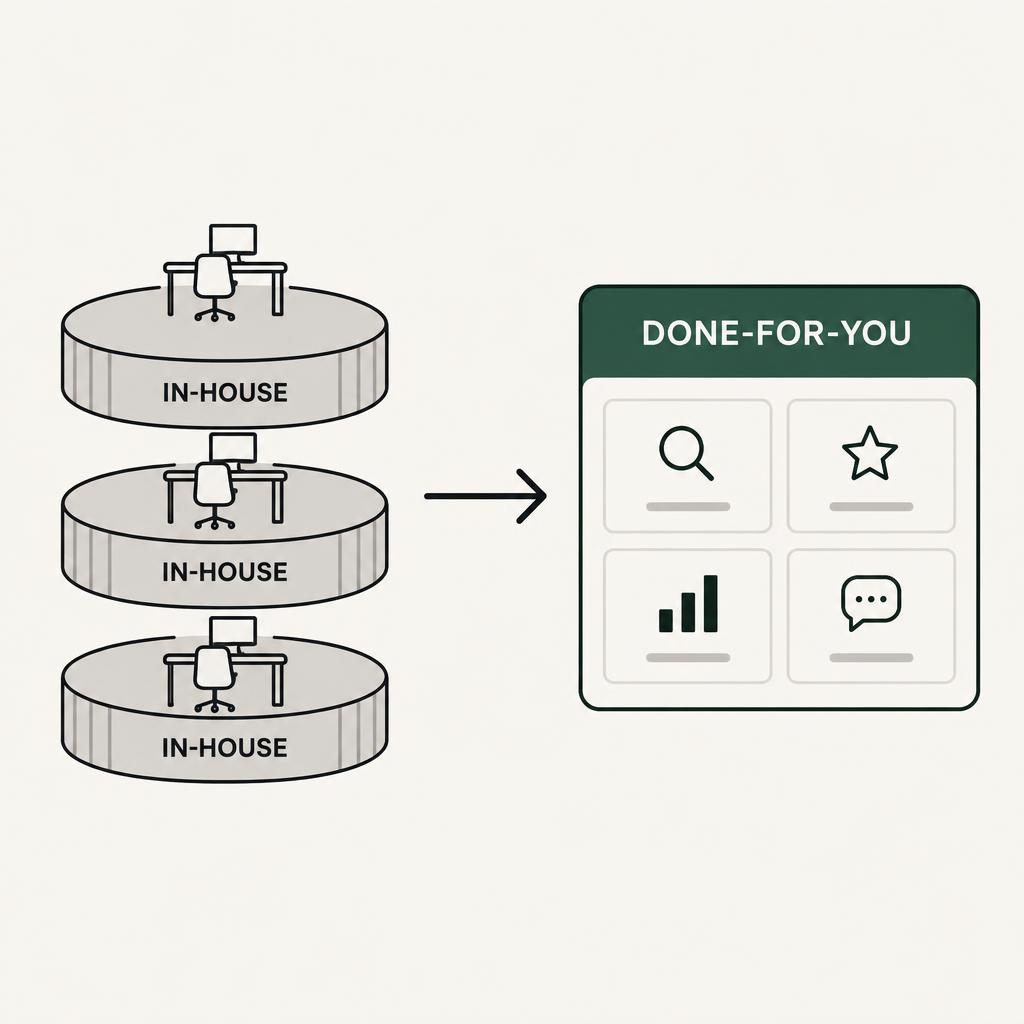
A single competent marketing generalist costs $50,000 to $70,000 a year in salary, before benefits, software and training. But one person was never a department. To cover the real workload — search visibility, reviews, social media, paid ads, websites, email and analytics — you need specialists, and each one narrows the coverage while widening the payroll.
Add the tool stack (a CRM, scheduling, email automation, reporting software, each with its own subscription) and the management burden of actually supervising the work, and a realistic small-business marketing department runs well into six figures annually. For most service businesses, that's two or three full-time hires to compete with businesses that solved the same problem a different way.
The hidden cost nobody budgets for: turnover
Salaries are the visible cost. The expensive one is continuity. When an in-house marketer leaves, they take the campaign history, the ad account knowledge and the vendor relationships with them. Rebuilding that institutional memory takes months — and marketing doesn't pause while you rebuild it. Rankings drift, review responses stop, ad campaigns run unsupervised.
What done-for-you actually means
A done-for-you marketing department replaces headcount with a system. Instead of three salaries, you get a team of specialists — SEO, paid ads, reputation, content, automation — already trained, already using enterprise tools, and already coordinated. The work doesn't stop when one person is on vacation, and nothing has to be re-taught when your business grows.
It also changes what you're buying. An employee is paid for hours; a done-for-you partner is accountable for outcomes: being found, being trusted and being chosen. That's the difference between a line item and an investment you can actually evaluate.
How to compare the two honestly
Put the same three questions to both options. First, what does it cost fully loaded — salary or fee, tools, management time and turnover risk included? Second, what does it cover — one channel or the whole path from first search to booked appointment? Third, who is accountable when results dip?
Run those questions against an in-house hire and the answer is usually: high fixed cost, partial coverage, and accountability that leaves with the employee. Run them against a well-built done-for-you system and the answer is a predictable monthly investment, full coverage and a team whose job is to show you the numbers.
Where AI changes the equation
The gap is widening. AI-powered automation now handles much of what used to require headcount: instant lead response, review requests, content drafting, after-hours call answering and reporting. Businesses with a managed system get the productivity of a large marketing team at a fraction of the cost. Businesses hiring one person at a time are competing against that — with a smaller team.
The takeaway
You don't need a marketing department. You need the outcomes a marketing department produces: visibility, trust and a steady flow of booked customers. For most small businesses, a done-for-you system delivers those outcomes faster and for less than the salary of a single mid-level hire — without the turnover risk.
Want to see what that would look like for your business? Get your free Snapshot Report and we'll show you where you stand and what it would take to grow.